Sunday, 25 November 2012

Fantastically Fruitful


Yesterday I harvested the first few fruits of our small apricot crop. Homegrown apricots fresh and warm from the tree are a world apart from those available in the supermarket, which seem to be either hard and tart or floury and tasteless. Mind you, apricots are probably our least successful crop - I suspect the varieties we have need more chilling hours than our climate usually provides - but the taste sensation of our precious few fruits is worth the effort.


Also being harvested at present are strawberries and youngberries, both producing in abundance. Any fruits we don't eat each day are washed, dried and frozen. Some will be used to make strawberry sorbet, the rest are kept until a cold winter's day when I will make jam. (There are two strawberry sorbet recipes in Gardens For All Seasons, one with mango and one so quick you won't believe it.)


Our mouths are watering for the nectarines, which should be ready to harvest in a week or so and which we watch every day in anticipation. Despite a quite bad case of curly leaf this season, the nectarines will give us a good crop; the peaches were more badly affected, but we'll still get a few. The Satsuma plums will not be ready for another couple of months. The dangling CD's  and windchimes you can see in the photos are our so-far-successful strategy for keeping the birds off the fruit.


The plums, nectarines, apricots and peaches are all from multigrafted trees grown on dwarfing rootstock, so we can have several productive fruits in a small area. There are also two multigrafted citrus trees, one of which still holds a few lemons waiting to be harvested.


The self-sown canteloupes in the vegie beds will give us delicious fruit in autumn. A feijoa tree planted a few years ago is fruiting for the first time and that too should fruit in autumn.
All this fruit (as well as the vegies and aquaponics system) is grown in quite a small space (one day I'll measure the area), no bigger than most suburban backyards.
Along with all this fruit, produce from our vegie garden is prolific at the moment. Last night, while Rodney caught and despatched most of the trout from the aquaponics system, I harvested the last of the parsnips, freeing that tank bed for more beans. The last of the broad beans are ready to pick, leaving that space available for corn. We are eating beans, broad beans, zucchini, red onions, mixed lettuce and baby Swiss chard. Tomatoes, cucumbers, garlic, potatoes and capsicums are developing nicely.


I haven't mentioned the numerous herbs that are in pots and other small spots; the nasturtium flowers and leaves that go in salads; the daylilies which we could eat but don't; the amaranth with its edible leaves and seeds, but which I'll be leaving so granddaughters can play with the long tassels; the sunflowers grown as a cubby for granddaughters . . .  It is a fantastically fruitful small food garden.


If you have any size of backyard (or front garden), you can grow lots of food. If you have a courtyard or balcony, you'll be surprised at how much you can grow once you put your mind to it. 

To get started in the garden see Creating Your Eco-Friendly Garden.
For heaps of ideas about growing food in small spaces see Fabulous Food From Every Small Garden.
To keep your garden in top shape all year round, have lots of fun in the garden and learn fascinating things about gardening and the environment see my new book Gardens For All Seasons
All published by CSIRO Publishing.

Saturday, 17 November 2012

Conversation With A Cocky Killer


In the local supermarket yesterday, I was behind an older lady at the checkout. I have been behind her before and know that she dithers and takes a long time to get her few purchases through. However, bearing in mind that it could be me dithering in the supermarket queue in the future, I am patient and understanding, assuring her, when she repeatedly apologises, that I don't mind the wait.

The lady's shopping included several packets of rolled oats, more than you would expect a single old person to need, but I didn't think much about it, maybe it was a bargain this week. The teenage checkout operator was sent scurrying to the back of the shop to fetch some cat mince for her. While we waited, she began to talk to me, telling me that she bought the oats to feed the cockies (sulphur-crested cockatoos) in her garden. They began visiting, apparently, during the drought a few years ago, she started feeding them out of kindness ('I'm too soft-hearted, I'm a soft touch when it comes to animals.') and they have stayed. She said that she knew many people did not like the cockies in their gardens and asked me if I liked them. I assured her that they frequently visited my red gums and that I didn't mind, whereupon I became, in her words, a 'very kind person'.


Before the checkout operator returned, she had time to tell me that a lot of the cockies got sick, their feathers became oily and their beaks were malformed so they couldn't eat. Some of them even died in her garden. 'But I look after them. I give them oats and sometimes buy them seeds as well.'

How could I tell this kind-hearted old lady that it was probably her 'kindness' in feeding them the wrong diet that was making them sick and killing them? I'm no expert on bird diseases, but think it's likely that her source of free food would be attracting more cockies than would normally visit a town garden and they would be infecting each other with whatever illness the inappropriate diet has brought about.

When the checkout operator returned and finished scanning her groceries, she gave him the chocolate bar she had bought, thanking him and saying, 'They're aways very kind to me in here'. By that time we had established that the checkout operator (indeed all the supermarket staff) were very kind to her, I was a very kind person for waiting patiently and engaging in a conversation with her (really more of a monologue) and she herself was kind because she fed the birds (and the cats, but that's another story!).

Oh dear, there is no way I could have told her she was killing the cockies with kindness.


Saturday, 10 November 2012

Nostalgia: Tears, Smiles and Open Gardens


I made a trip to Rufffy today, where Bradley and Stacy went to primary school. Though it was far from my first trip back to the area since we left there 10 years ago, such trips can still arouse feelings of nostalgia for what were, in retrospect, happy (most of the time) years. The school is still there, though not as a school any longer; it is now a community centre. Still there, too, are the bricks with Bradley's and Stacy's names on them in a little paved area, and if they were looked at through a teary haze, no one was there to notice.


The reason for the trip was an art show, held in the Ruffy Hall, scene of many an excruciatingly long and uncomfortable school concert, where the children of this small, isolated community gained confidence and showed off their developing skills through public performances. The hall has changed significantly, but it was not too hard to replace (in my imagination) the works of art that were displayed with smiling, expectant faces and the buzz of excited youngsters who knew that, after the performance, there would be food and a visit from Santa.


Part of the attraction today was the fact that there were several open gardens in the district to visit. These were all large gardens, set around impressive homestead buildings. I was able to take numerous photos and enjoy the ambience of gardens that were themselves works of art, lovingly tended by their proud owners who generously opened them today to raise money for improvements to the hall. There were so many photo opportunities that it is hard to choose a few to share with you, maybe there'll be some more another day. I hope they make you smile.


The cattle, at the top, watched me as I admired the irises, below.


Wednesday, 31 October 2012

The Snail Stomp

Sensitive souls and snail lovers, please stop here.


It rained early this morning, after quite a dry spell here. At 10:30 am the rain seemed to have stopped so I set off for a walk, deciding to first stroll around the garden.

What did I see but an army of snails, brought out of hiding by the dampness, sliding across the grass, all over the pigface, up between the spines of cactus plants. I am not kidding when I say they were actually in clusters, especially around/in/under the pigface. This has always been a snaily garden, even when we first bought the land and there was no garden here, but, this morning's battalions of them were almost beyond belief.


An hour and hundreds of dead snails later, I set off on my walk.

You can have your beer traps and your environment-friendly baits (both moderately effective) and whatever other traps you can devise, nothing, but nothing, beats a determined snail stomp on a damp day after a dry spell.

I have decided that the pigface, which has spread way beyond where I originally wanted it anyway, has to go. The snails love it too much.

Sunday, 28 October 2012

It's The Vibes


This post is a quick follow-up to yesterday's. I wrote about talking to the flowers and speculated about how/if plants respond to speech/music/vibrations. Last night I watched David Attenborough's 'Kingdom Of Plants'. Wow! 

It seems there is a particular flower that emits its pollen in response to the pitch of the buzz of a particular bee. Hence, in the wild, it relies totally on that one bee species for its pollination. How amazing is that? As said bee is not present at Kew Gardens in London, where the show was filmed, David Attenborough then demonstrated the process using a tuning fork.

Yes, plants do respond to vibrations, so it is possible that they respond to the vibrations of the human voice as well.

I can't help wondering: How specific is this bee-pollinator relationship if the flower responds to a tuning fork? Perhaps there are other bees or insects that emit a sound of the required pitch. 

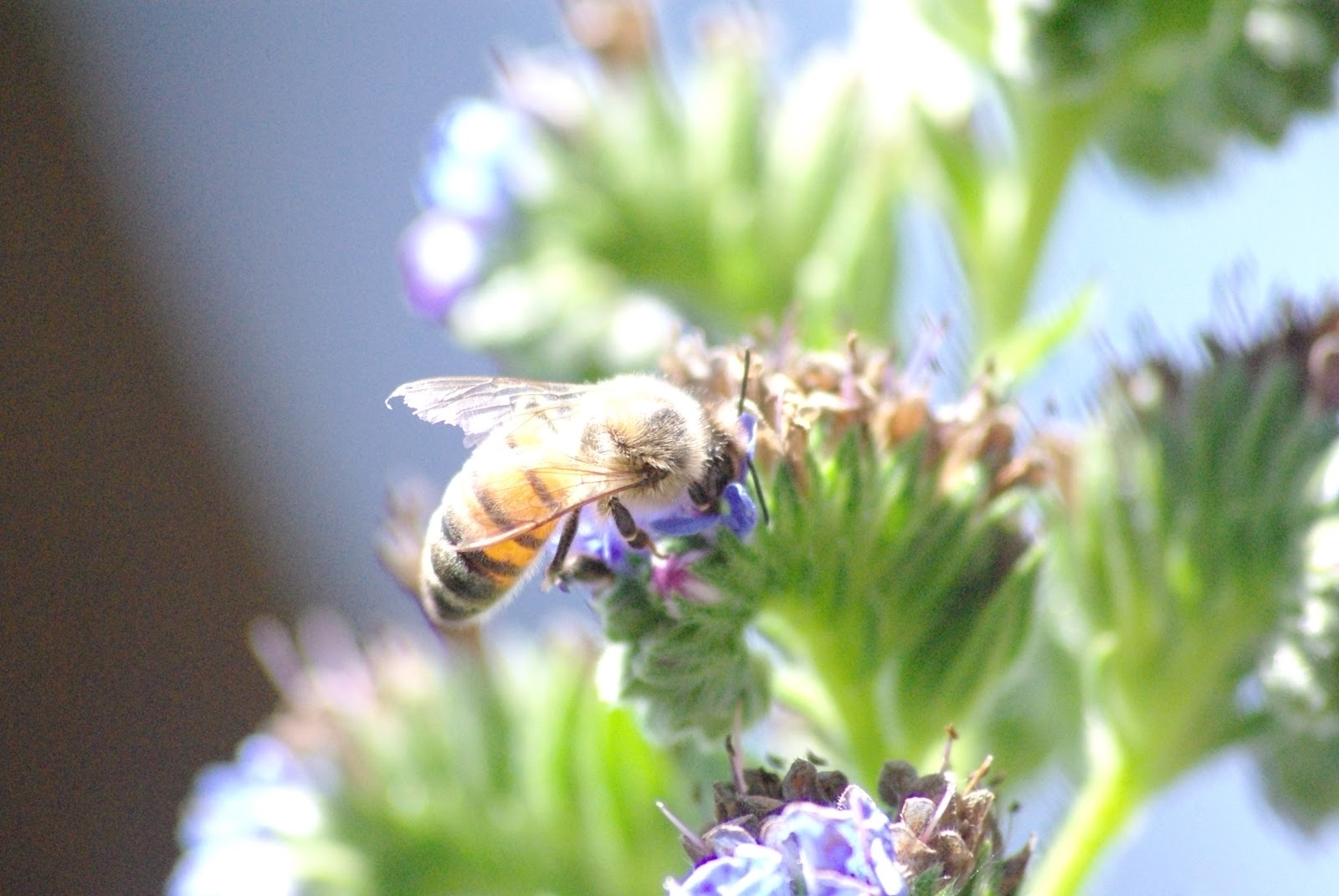
The bee and flower pictured are not those referred to in the program.

Saturday, 27 October 2012

Talking To The Flowers


Someone recently asked me about whether I talked to my plants and I was a little surprised to immediately realise that I do. It is not in any conscious way, but I do find myself welcoming back my favourite flowers as they bloom each season, stroking their petals and telling them how much I appreciate their beauty. When I plant vegie seedlings, I often give them some vocal encouragement to grow strong and productive. Then, when I harvest the crop, I thank the plants for their bounty.


Does it make a difference to how they grow? It is not as if they can actually hear my voice, but perhaps they sense the benevolent vibrations. I remember reading some years ago about experiments with plants and music. Apparently, plants exposed to classical music thrived more than did those exposed to loud rock music or a continuous monotone. Mabe it is the vibrations that make the difference. Then again, maybe the classical music also appealed to beneficial insects, which preyed on the pests and kept those plants healthier.


Perhaps my appreciative remarks to the plants are more for my own benefit. Do they help me connect more with the plants and thus take better care of them than I might otherwise?


I don't have the answers, but it is interesting to speculate. Maybe an experiment is called for; one in which I yell at some plants and speak softly to others. Hmmm, I think this experiment should have been done when we lived on a farm, with no neighbours in earshot. It is not one for a backyard surrounded on all sides by other people.


Talking to the flowers is just another way to connect with the natural world, along with stroking petals and tree trunks, crushing aromatic leaves to sniff and sitting in quiet contemplation surrounded by flowers, perfumes, buzzing bees and bird song. If it turns out to have some real benefit to the plants as well, that would be another natural phenomenon to wonder at.


Today's photos feature some of the flowers I have been welcoming back this month. I hope they bring a little joy to your day.

Sunday, 14 October 2012

All A-Buzzzz


Did you know that about a third of our food plants worldwide are pollinated by bees? It is no exageration to say that without bees there would be a food crisis of massive proportions, even in the developed world.

The October garden is in full bloom and bees are buzzing industriously from plant to plant. Native wax flowers, echiums and both white- and pink-flowered leptospermums are favoured this month. In the summer they will be attracted to the buddleias and lavenders. Bees see colours differently from humans and are especially attracted to intense blue and purple colours, but right here, right now, they have no problem collecting enough pollen from the many white flowers in bloom in my garden.


Plants depend on bees and other pollinating inserts to transfer pollen from the anther (male part of flower) to the stigma (female part of flower) so seeds can develop, the plant can reproduce and and the species survive. In return, the pollinating insect gets nectar and/or pollen, high-energy foods that it needs for its own survival. Plants and their pollinating insects have developed some amazing relationships, some of which are so interdependent that the one could not survive without the other.


The bees buzzing around my garden perform a free service for me as they collect their bounty from the flowers. Many of them pollinate my fruit trees and vegetable crops. When the fruit trees are in blossom, I watch with interest as the bees work the flowers, filling their pollen sacs with nutritious pollen to take back to the hive. (See the full pollen sac visible in the photo above.) I know that in a few months time I will be enjoying peaches, nectarines, plums, apricots and strawberries as a result of their work. 

I grow lavender in the vegie garden to ensure that enough bees are attracted to the area to pollinate pumpkins, cucumbers, zucchinis and other crops. Borage is another plant that bees seem to love and that can easily find a place in the vegie garden.


The value of bees to humans cannot be overstated. To attract bees to your garden, plant some of the flowers mentioned here and avoid using insecticides, which kill bees and other beneficial insects as well as pest insects.

My three-year-old granddaughter Ellie has recently discovered her first imaginary friend, a bee called Bumblebee. Perhaps she has no conscious knowledge of how apt it is to think of bees as friends, but maybe she is displaying a core of inner wisdom that many adults seem to lack.

My recently released book Gardens For All Seasons has a section titled 'Pollinate or Perish', in which I discuss in much more detail the role of pollinating insects, their importance, and some fascinating flower/pollinator relationships, some of which still leave me astounded. You can see sample pages and a short video about the book at: www.publish.csiro.au/pid/6807