Wednesday, 31 October 2012

The Snail Stomp

Sensitive souls and snail lovers, please stop here.


It rained early this morning, after quite a dry spell here. At 10:30 am the rain seemed to have stopped so I set off for a walk, deciding to first stroll around the garden.

What did I see but an army of snails, brought out of hiding by the dampness, sliding across the grass, all over the pigface, up between the spines of cactus plants. I am not kidding when I say they were actually in clusters, especially around/in/under the pigface. This has always been a snaily garden, even when we first bought the land and there was no garden here, but, this morning's battalions of them were almost beyond belief.


An hour and hundreds of dead snails later, I set off on my walk.

You can have your beer traps and your environment-friendly baits (both moderately effective) and whatever other traps you can devise, nothing, but nothing, beats a determined snail stomp on a damp day after a dry spell.

I have decided that the pigface, which has spread way beyond where I originally wanted it anyway, has to go. The snails love it too much.

Sunday, 28 October 2012

It's The Vibes


This post is a quick follow-up to yesterday's. I wrote about talking to the flowers and speculated about how/if plants respond to speech/music/vibrations. Last night I watched David Attenborough's 'Kingdom Of Plants'. Wow! 

It seems there is a particular flower that emits its pollen in response to the pitch of the buzz of a particular bee. Hence, in the wild, it relies totally on that one bee species for its pollination. How amazing is that? As said bee is not present at Kew Gardens in London, where the show was filmed, David Attenborough then demonstrated the process using a tuning fork.

Yes, plants do respond to vibrations, so it is possible that they respond to the vibrations of the human voice as well.

I can't help wondering: How specific is this bee-pollinator relationship if the flower responds to a tuning fork? Perhaps there are other bees or insects that emit a sound of the required pitch. 

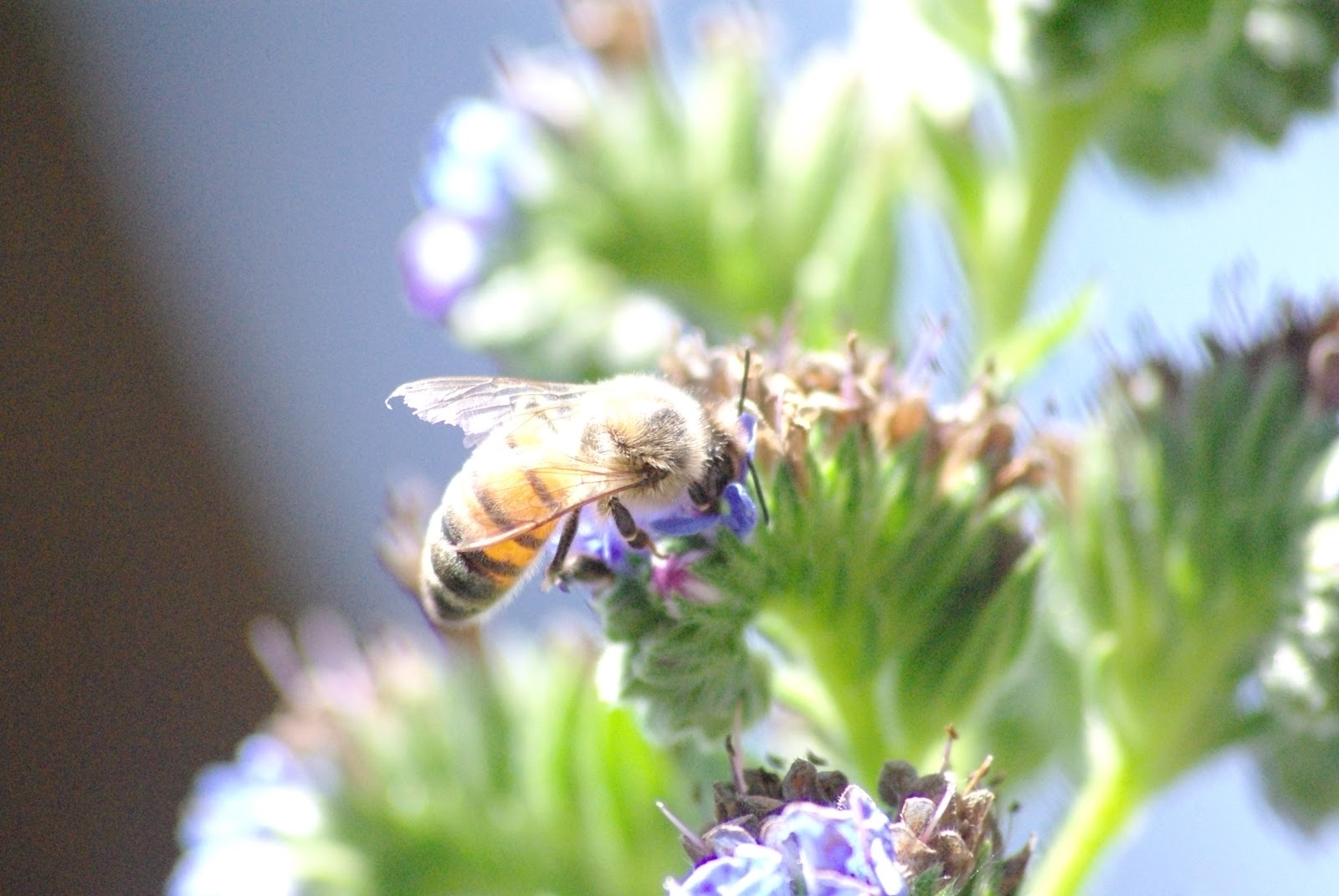
The bee and flower pictured are not those referred to in the program.

Saturday, 27 October 2012

Talking To The Flowers


Someone recently asked me about whether I talked to my plants and I was a little surprised to immediately realise that I do. It is not in any conscious way, but I do find myself welcoming back my favourite flowers as they bloom each season, stroking their petals and telling them how much I appreciate their beauty. When I plant vegie seedlings, I often give them some vocal encouragement to grow strong and productive. Then, when I harvest the crop, I thank the plants for their bounty.


Does it make a difference to how they grow? It is not as if they can actually hear my voice, but perhaps they sense the benevolent vibrations. I remember reading some years ago about experiments with plants and music. Apparently, plants exposed to classical music thrived more than did those exposed to loud rock music or a continuous monotone. Mabe it is the vibrations that make the difference. Then again, maybe the classical music also appealed to beneficial insects, which preyed on the pests and kept those plants healthier.


Perhaps my appreciative remarks to the plants are more for my own benefit. Do they help me connect more with the plants and thus take better care of them than I might otherwise?


I don't have the answers, but it is interesting to speculate. Maybe an experiment is called for; one in which I yell at some plants and speak softly to others. Hmmm, I think this experiment should have been done when we lived on a farm, with no neighbours in earshot. It is not one for a backyard surrounded on all sides by other people.


Talking to the flowers is just another way to connect with the natural world, along with stroking petals and tree trunks, crushing aromatic leaves to sniff and sitting in quiet contemplation surrounded by flowers, perfumes, buzzing bees and bird song. If it turns out to have some real benefit to the plants as well, that would be another natural phenomenon to wonder at.


Today's photos feature some of the flowers I have been welcoming back this month. I hope they bring a little joy to your day.

Sunday, 14 October 2012

All A-Buzzzz


Did you know that about a third of our food plants worldwide are pollinated by bees? It is no exageration to say that without bees there would be a food crisis of massive proportions, even in the developed world.

The October garden is in full bloom and bees are buzzing industriously from plant to plant. Native wax flowers, echiums and both white- and pink-flowered leptospermums are favoured this month. In the summer they will be attracted to the buddleias and lavenders. Bees see colours differently from humans and are especially attracted to intense blue and purple colours, but right here, right now, they have no problem collecting enough pollen from the many white flowers in bloom in my garden.


Plants depend on bees and other pollinating inserts to transfer pollen from the anther (male part of flower) to the stigma (female part of flower) so seeds can develop, the plant can reproduce and and the species survive. In return, the pollinating insect gets nectar and/or pollen, high-energy foods that it needs for its own survival. Plants and their pollinating insects have developed some amazing relationships, some of which are so interdependent that the one could not survive without the other.


The bees buzzing around my garden perform a free service for me as they collect their bounty from the flowers. Many of them pollinate my fruit trees and vegetable crops. When the fruit trees are in blossom, I watch with interest as the bees work the flowers, filling their pollen sacs with nutritious pollen to take back to the hive. (See the full pollen sac visible in the photo above.) I know that in a few months time I will be enjoying peaches, nectarines, plums, apricots and strawberries as a result of their work. 

I grow lavender in the vegie garden to ensure that enough bees are attracted to the area to pollinate pumpkins, cucumbers, zucchinis and other crops. Borage is another plant that bees seem to love and that can easily find a place in the vegie garden.


The value of bees to humans cannot be overstated. To attract bees to your garden, plant some of the flowers mentioned here and avoid using insecticides, which kill bees and other beneficial insects as well as pest insects.

My three-year-old granddaughter Ellie has recently discovered her first imaginary friend, a bee called Bumblebee. Perhaps she has no conscious knowledge of how apt it is to think of bees as friends, but maybe she is displaying a core of inner wisdom that many adults seem to lack.

My recently released book Gardens For All Seasons has a section titled 'Pollinate or Perish', in which I discuss in much more detail the role of pollinating insects, their importance, and some fascinating flower/pollinator relationships, some of which still leave me astounded. You can see sample pages and a short video about the book at: www.publish.csiro.au/pid/6807

Tuesday, 25 September 2012

Jewels In The Garden


No, I haven't struck it rich, not in monetary terms anyway, but I have noticed these gorgeous shiny beetles fossicking around on the wax flowers. I am calling them jewel beetles, though I'm not totally sure that is right. After some research on the matter, I was not able to find anything the same pictured. There are 1200 species of jewel beetles so perhaps it's not surprising that 'my' beetles were not pictured in my insect identification book or on a number of internet sites I visited. If anyone knows any different, I'd love to know, but for me, for now, they are jewel beetles glowing in the sun among the white flowers.


Much more prolific are the bees buzzing around the same bushes. They don't look like jewels, but they are worth their weight in precious gems for the invaluable pollination job they do. Did you know that about a third of all the food we eat is pollinated by bees? How can you put a value on that? I'm very happy to see so many around my garden because they pollinate my fruit and vegetable crops while collecting pollen and nectar for their own purposes.


As I trawled the internet finding out about jewel beetles, I was amazed at the diversity and beauty to be found in the beetle world and astonished to find that you can buy earrings made from beetles and framed beetles to hang on your wall. I think I'll stick with admiring them where they belong, in the garden.

Monday, 17 September 2012

Welcome Cheerfulness


The colour in the garden this month is predominantly yellow. All the wattles are in flower and the calendulas are in full golden bloom, though they do flower for most of the year. All this yellow makes the fence art feature, with its yellow background, even more noticeable. The vibrant colour of the wattles with the fresh spring green of foliage and grass can't help but bring a smile. It's cheeerfulness after gloomy winter weather is very welcome. Enough words, here are some photos to cheer up your day.


Wednesday, 12 September 2012

Inspiration Is Everywhere

Sometimes inspiration for a new garden bed or structure comes from odd places. Something catches your eye and you start to think about how you can adapt it to your own situation. It might be a while before the inspiration clicks and the finished product might not look too much like the original, but the link is there.

One very unlikely inspiration came from a section of freeway architecture. Travelling to Melbourne from the north, along the Hume Freeway, when you get close to the city there is a section of road lined by very large, blue rectangular poles surrounded by low-growing shrubs. I used to look at it admiringly (Melbourne has the best freeway archecture around) and ponder on how I could adapt the idea to a very small garden scale. Eventually, rectangular blue pots edging a section of garden bed emerged. I wish I had a photo of the original freeway architecture to post here, but anyone who has travelled that section will know it.


Another inspiration came from the Cranbourne Botanic Garden. We saw a black wall-type structure, reminiscent of the old-fashioned shadow boxes. It had coloured glass in some sections and ornamental features in others. Fortunately, both Rodney and I liked it and he was more than willing to translate the idea into our own feature wall edging the deck.